- Licensed & Insured Specialists
- Workmanship Warranty
- Free On-Site Assessment
- Serving All of Gauteng
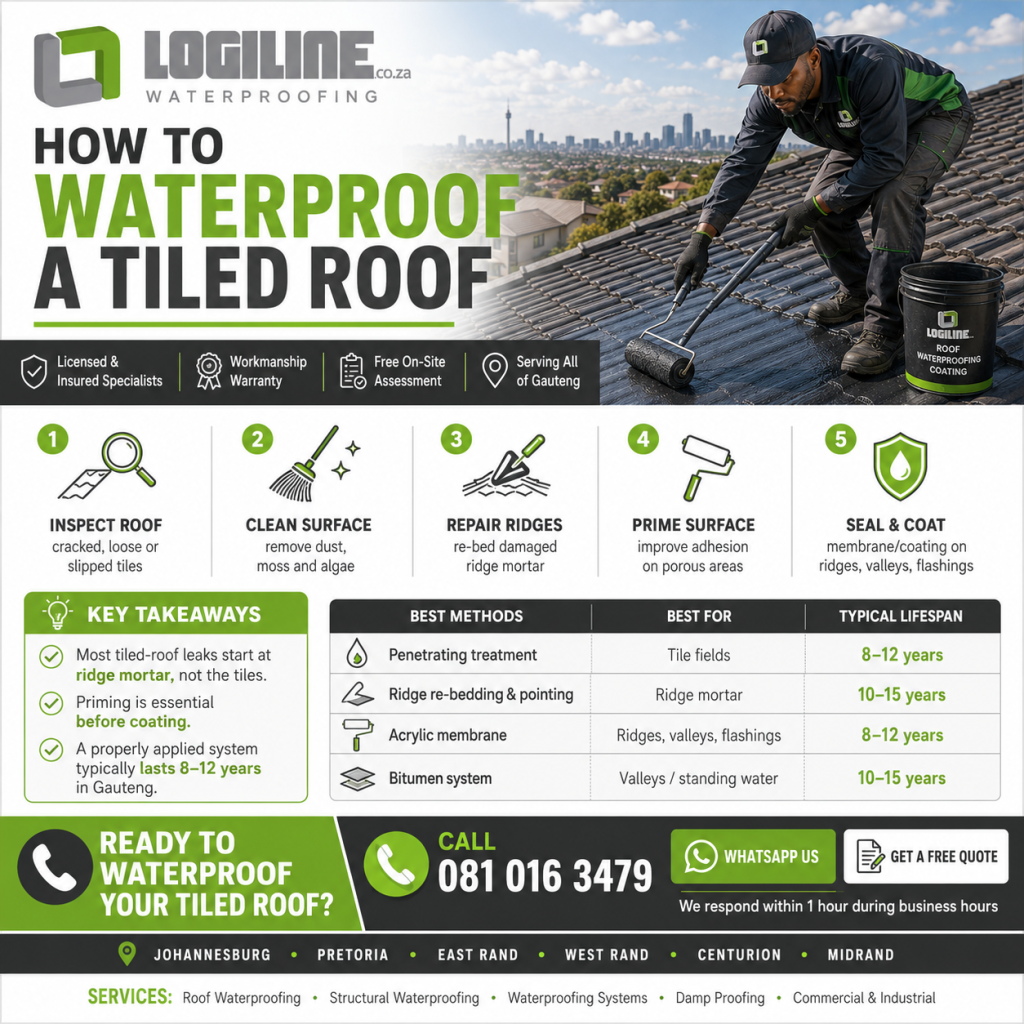
Waterproofing a tiled roof involves five stages: inspecting the roof for cracked or loose tiles, clearing dust and moss from the surface, repairing damaged ridge mortar, priming porous areas, and applying a flexible waterproof coating or membrane system to ridges, valleys and flashings. Skipping any one of these stages, particularly priming, is the most common reason a tile roof waterproofing job fails within a few years rather than lasting closer to a decade.
Key Takeaways
- Tile roof waterproofing starts with an inspection, not with a coating or a paintbrush.
- Ridge mortar, not the tiles themselves, is the most frequent source of leaks on Gauteng roofs.
- Surfaces must be primed before any membrane or coating is applied, or adhesion fails early.
- A correctly applied waterproofing system typically lasts eight to twelve years in Gauteng conditions.
- Terracotta, clay and concrete tiles each respond differently to penetrating treatments.
Inspecting and Preparing a Tiled Roof Before Waterproofing
Every tiled roof waterproofing job starts on foot, not on paper. Walking the full roof surface reveals hairline cracks running through individual tiles, tiles that have slipped from their battens, and ridge capping where the mortar bed has eroded into gaps. These gaps are where most leaks begin, since wind-driven rain during a Gauteng thunderstorm finds its way through a crack far more easily than through the tile field itself.
Once the inspection is done, the surface needs a proper clean before any waterproofing work can start. A wire brush or a pressure washer with the nozzle angled downward lifts dust, moss and algae without forcing water up under the tiles and into the roof space. Loose or crumbling mortar is raked out completely and rebuilt with a fibre-reinforced repair compound, and any tile that is cracked through rather than just chipped gets replaced before the next stage begins. Logiline Waterproofing’s tile roof waterproofing service follows this sequence on every job across Gauteng’s tiled suburbs, because the climate here, with sharp daily temperature swings and long dry spells followed by heavy summer rain, puts constant stress on ridge mortar specifically.
Priming and Sealing a Tiled Roof Before Coating
Tiles, and especially repaired mortar joints, are porous. Applying a coating directly onto an untreated surface gives the product little to grip, and it can peel or flake off within a season. A deep-penetrating primer or bonding liquid is worked into the tile surface and the repaired ridges first, locking down loose particles and giving the topcoats something stable to bond to.
Roof penetrations need separate attention during this stage. Vents, solar panel mounts, and flashing edges around chimneys or parapet walls are common leak points because they interrupt the tile field and rely on a sealant rather than overlapping tiles to stay watertight. A flexible sealant, polyurethane, or paintable silicone is used around each of these points, since a rigid product would crack the first time the roof expands and contracts in the heat. Choosing which type of waterproofing system suits a particular roof often comes down to how many penetrations and junctions it has, not just its overall size.
Applying the Waterproof Membrane and Coating System
With the surface clean, repaired and primed, a base coat of acrylic or rubberised waterproofing compound goes down first. A reinforcing polyester or stretch-seal membrane is embedded into this wet base coat along ridge lines, joints and overlaps, the exact points identified during the inspection as the weak spots in the roof. This membrane bridges hairline movement in the mortar without tearing, something a coating alone cannot do.
Once the membrane has cured, two to three topcoats of a UV-resistant acrylic or elastomeric roof coating are applied over the membrane and flashings for a seamless, water-shedding surface. Valleys and other areas that hold running water for longer periods sometimes call for a heavier-duty bitumen waterproofing system instead of a purely acrylic build-up, since bitumen handles standing water with more margin. Logiline Waterproofing’s broader roof waterproofing services cover this full range of systems, matched to the specific roof rather than applied as a single default product.
How Long Tile Roof Waterproofing Lasts in Gauteng
A correctly applied tile roof waterproofing system holds up for eight to twelve years before it needs reapplication, though the Highveld’s intense UV exposure and wide temperature swings between day and night shorten that range on north- and west-facing slopes compared with more sheltered aspects. Product choice matters here too, since how long bitumen waterproofing lasts compared with an acrylic tile treatment depends heavily on which part of the roof it protects and how much direct sun it sees.
The table below sets out the main methods used to waterproof a tiled roof, and where each one performs best.
| Method | Best suited to | Typical lifespan | Key advantage |
|---|---|---|---|
| Penetrating tile treatment | Terracotta, clay and concrete tile fields | 8 to 12 years | Preserves the tile’s natural appearance |
| Ridge re-bedding and pointing | Cracked or eroded ridge mortar | 10 to 15 years | Fixes the single most common leak source |
| Acrylic membrane system | Ridges, valleys and flashings | 8 to 12 years | Flexes with temperature change, UV stable |
| Bitumen (torch-on) system | Valleys and areas with standing water | 10 to 15 years | Handles ponding water without failing |
A cracked ridge or a patch of moss on the tiles is easier to fix before the next Gauteng thunderstorm than after it. Call 081 016 3479 for a free on-site roof assessment.
Choosing a Tile Roof Waterproofing Specialist in Gauteng
Waterproofing a tiled roof properly needs someone who walks the full roof rather than assessing it from the ground, carries public liability insurance, and backs the work with a written warranty. Logiline Waterproofing serves homes and complexes throughout the region, including waterproofing in Johannesburg, Pretoria, Centurion and the East and West Rand, and works with terracotta, clay and concrete tiles under the same Highveld conditions each time.
Because access, roof pitch, the number of ridge tiles needing re-bedding and any tile replacement all affect the scope of work, a free on-site assessment gives an accurate picture before anything is scheduled. Homeowners weighing up the overall project can also review what affects the cost to waterproof a roof in Gauteng alongside this guide to understand the full process from start to finish.
Frequently Asked Questions
How do I know if my tiled roof needs waterproofing?
Can a tiled roof be waterproofed without replacing the tiles?
How long does tile roof waterproofing last in Gauteng?
What is the best waterproofing method for a tiled roof?
Does waterproofing stop moss and algae growing on tiles?
← Back to Tile Roof Waterproofing | All Roof Waterproofing Services
Further reading: waterproofing methods and materials, and roofing conditions across Gauteng.