
Uncategorized - Logiline Waterproofing
📞 Call Now 💬 WhatsApp

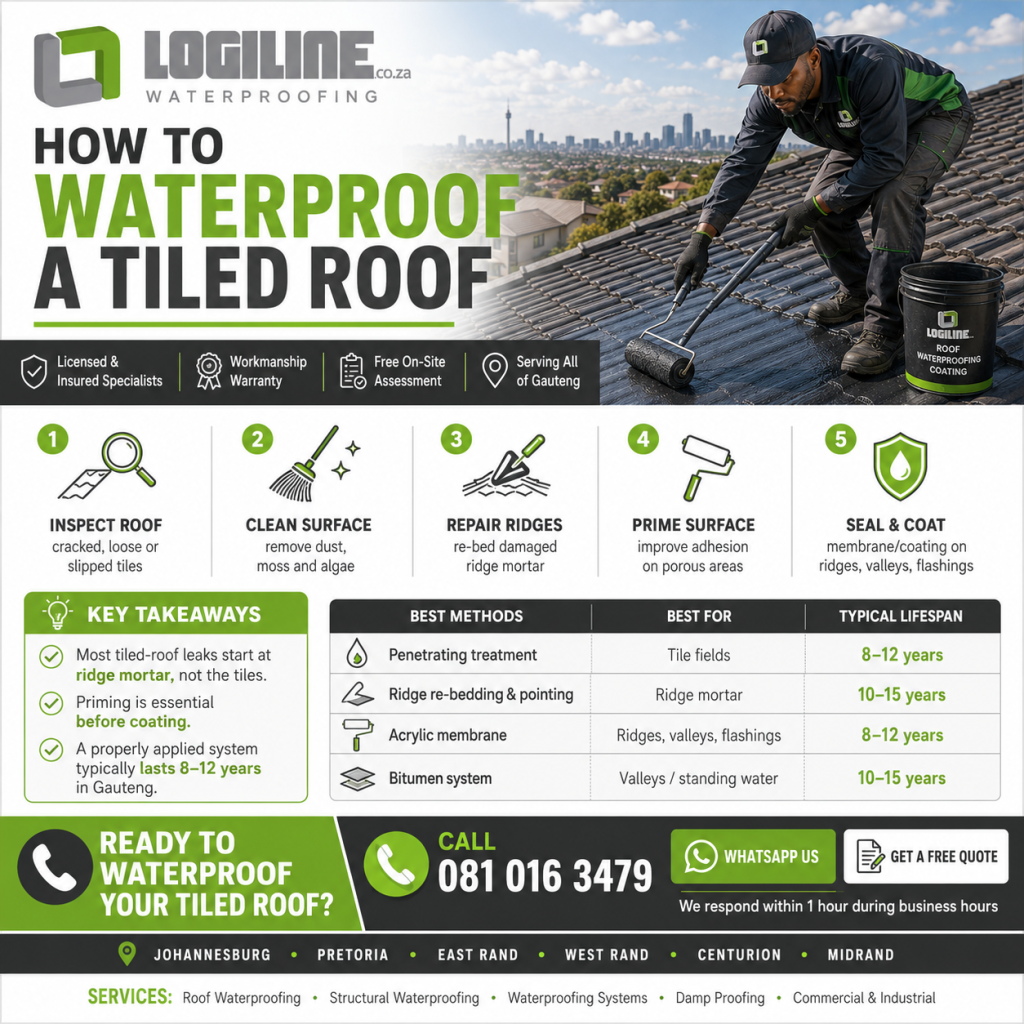
How to waterproof a tiled roof?

  • Licensed & Insured Specialists
  • Workmanship Warranty
  • Free On-Site Assessment
  • Serving All of Gauteng

Waterproofing a tiled roof involves five stages: inspecting the roof for cracked or loose tiles, clearing dust and moss from the surface, repairing damaged ridge mortar, priming porous areas, and applying a flexible waterproof coating or membrane system to ridges, valleys and flashings. Skipping any one of these stages, particularly priming, is the most common reason a tile roof waterproofing job fails within a few years rather than lasting closer to a decade.

Key Takeaways

  • Tile roof waterproofing starts with an inspection, not with a coating or a paintbrush.
  • Ridge mortar, not the tiles themselves, is the most frequent source of leaks on Gauteng roofs.
  • Surfaces must be primed before any membrane or coating is applied, or adhesion fails early.
  • A correctly applied waterproofing system typically lasts eight to twelve years in Gauteng conditions.
  • Terracotta, clay and concrete tiles each respond differently to penetrating treatments.

Inspecting and Preparing a Tiled Roof Before Waterproofing

Every tiled roof waterproofing job starts on foot, not on paper. Walking the full roof surface reveals hairline cracks running through individual tiles, tiles that have slipped from their battens, and ridge capping where the mortar bed has eroded into gaps. These gaps are where most leaks begin, since wind-driven rain during a Gauteng thunderstorm finds its way through a crack far more easily than through the tile field itself.

Once the inspection is done, the surface needs a proper clean before any waterproofing work can start. A wire brush or a pressure washer with the nozzle angled downward lifts dust, moss and algae without forcing water up under the tiles and into the roof space. Loose or crumbling mortar is raked out completely and rebuilt with a fibre-reinforced repair compound, and any tile that is cracked through rather than just chipped gets replaced before the next stage begins. Logiline Waterproofing’s tile roof waterproofing service follows this sequence on every job across Gauteng’s tiled suburbs, because the climate here, with sharp daily temperature swings and long dry spells followed by heavy summer rain, puts constant stress on ridge mortar specifically.

Priming and Sealing a Tiled Roof Before Coating

Tiles, and especially repaired mortar joints, are porous. Applying a coating directly onto an untreated surface gives the product little to grip, and it can peel or flake off within a season. A deep-penetrating primer or bonding liquid is worked into the tile surface and the repaired ridges first, locking down loose particles and giving the topcoats something stable to bond to.

Roof penetrations need separate attention during this stage. Vents, solar panel mounts, and flashing edges around chimneys or parapet walls are common leak points because they interrupt the tile field and rely on a sealant rather than overlapping tiles to stay watertight. A flexible sealant, polyurethane, or paintable silicone is used around each of these points, since a rigid product would crack the first time the roof expands and contracts in the heat. Choosing which type of waterproofing system suits a particular roof often comes down to how many penetrations and junctions it has, not just its overall size.

Applying the Waterproof Membrane and Coating System

With the surface clean, repaired and primed, a base coat of acrylic or rubberised waterproofing compound goes down first. A reinforcing polyester or stretch-seal membrane is embedded into this wet base coat along ridge lines, joints and overlaps, the exact points identified during the inspection as the weak spots in the roof. This membrane bridges hairline movement in the mortar without tearing, something a coating alone cannot do.

Once the membrane has cured, two to three topcoats of a UV-resistant acrylic or elastomeric roof coating are applied over the membrane and flashings for a seamless, water-shedding surface. Valleys and other areas that hold running water for longer periods sometimes call for a heavier-duty bitumen waterproofing system instead of a purely acrylic build-up, since bitumen handles standing water with more margin. Logiline Waterproofing’s broader roof waterproofing services cover this full range of systems, matched to the specific roof rather than applied as a single default product.

How Long Tile Roof Waterproofing Lasts in Gauteng

A correctly applied tile roof waterproofing system holds up for eight to twelve years before it needs reapplication, though the Highveld’s intense UV exposure and wide temperature swings between day and night shorten that range on north- and west-facing slopes compared with more sheltered aspects. Product choice matters here too, since how long bitumen waterproofing lasts compared with an acrylic tile treatment depends heavily on which part of the roof it protects and how much direct sun it sees.

The table below sets out the main methods used to waterproof a tiled roof, and where each one performs best.

MethodBest suited toTypical lifespanKey advantage
Penetrating tile treatmentTerracotta, clay and concrete tile fields8 to 12 yearsPreserves the tile’s natural appearance
Ridge re-bedding and pointingCracked or eroded ridge mortar10 to 15 yearsFixes the single most common leak source
Acrylic membrane systemRidges, valleys and flashings8 to 12 yearsFlexes with temperature change, UV stable
Bitumen (torch-on) systemValleys and areas with standing water10 to 15 yearsHandles ponding water without failing

A cracked ridge or a patch of moss on the tiles is easier to fix before the next Gauteng thunderstorm than after it. Call 081 016 3479 for a free on-site roof assessment.

Choosing a Tile Roof Waterproofing Specialist in Gauteng

Waterproofing a tiled roof properly needs someone who walks the full roof rather than assessing it from the ground, carries public liability insurance, and backs the work with a written warranty. Logiline Waterproofing serves homes and complexes throughout the region, including waterproofing in Johannesburg, Pretoria, Centurion and the East and West Rand, and works with terracotta, clay and concrete tiles under the same Highveld conditions each time.

Because access, roof pitch, the number of ridge tiles needing re-bedding and any tile replacement all affect the scope of work, a free on-site assessment gives an accurate picture before anything is scheduled. Homeowners weighing up the overall project can also review what affects the cost to waterproof a roof in Gauteng alongside this guide to understand the full process from start to finish.

Frequently Asked Questions

How do I know if my tiled roof needs waterproofing?

Look for ceiling stains after rain, moss or algae on the tile surface, crumbling or missing ridge mortar, and tiles more than fifteen years old with no treatment history. Mortar debris collecting in the gutters is usually a clear sign the ridges need attention.

Can a tiled roof be waterproofed without replacing the tiles?

In most cases, yes. The process cleans the surface, re-beds cracked ridges, and applies a penetrating treatment or membrane system over the existing tiles. Full tile replacement is only needed where individual tiles are structurally broken rather than just worn.

How long does tile roof waterproofing last in Gauteng?

A correctly applied system generally lasts eight to twelve years, though Highveld UV exposure and daily temperature swings can shorten that on more exposed roof faces. Product selection and correct surface preparation both affect the final lifespan.

What is the best waterproofing method for a tiled roof?

There is no single best method for every roof. Ridge lines usually need re-bedding and an acrylic membrane, while valleys holding standing water often perform better with a bitumen system, so the right approach depends on where the roof is failing.

Does waterproofing stop moss and algae growing on tiles?

A biocide wash removes existing moss and algae before waterproofing begins, and the sealed, less porous surface left behind makes regrowth slower. It does not make regrowth impossible, so shaded, damp-prone roof faces may still need periodic cleaning.

Further reading: waterproofing methods and materials, and roofing conditions across Gauteng.
Ready to Waterproof Your Tiled Roof? Get a Free Assessment

Call 081 016 3479, licensed & insured, all of Gauteng covered.

How to waterproof a tiled roof

How much does it cost to waterproof a roof in Gauteng?

  • Licensed & Insured Specialists
  • Workmanship Warranty
  • Free On-Site Assessment
  • Serving All of Gauteng

The cost to waterproof a roof in Gauteng depends on the size of the roof, its pitch, the waterproofing system required, and how much repair work the surface needs before any coating goes down. There is no single, fixed roof waterproofing cost that applies to every property, since a small tiled roof in reasonable condition takes far less time and material than a large flat concrete roof with cracked screed and standing water. Logiline Waterproofing prices every job after a free, on-site assessment, so the true cost of roof waterproofing is only confirmed once an inspector has walked the roof and identified exactly what needs doing.

Key Takeaways

  • Roof waterproofing cost in Gauteng is driven by roof size, pitch, material and current condition, not a flat rate.
  • Tile roofs generally cost less to waterproof than large flat concrete roofs, mainly due to surface area and access.
  • Ridge re-bedding, screed repairs, tile replacement and reflective coatings all add to the total cost of roof waterproofing.
  • Difficult access, such as steep pitches or multi storey buildings, increases labour time and therefore the final price.
  • A written quotation always follows the on-site inspection, so the cost to waterproof a roof is confirmed before any work begins.

What Determines the Cost of Roof Waterproofing in Gauteng

Several factors combine to set the cost of roof waterproofing on any given property. Roof size is the clearest driver, since waterproofing is priced per square metre of surface treated, and a larger roof simply needs more product and more labour hours. Pitch matters too, since a steep tiled roof needs harnesses, scaffolding or rope access in places a flat roof never would, and that access time gets added to the roof waterproofing cost. The existing condition of the roof plays an equally large part. A roof that has never leaked, with sound mortar, tiles or membrane, costs far less to treat than one with years of deferred maintenance behind it. Logiline Waterproofing’s roof waterproofing services in Gauteng cover tile, concrete and IBR roofs, and each system carries its own cost profile depending on the treatment and preparation required.

Cost Factors by Roof Type

Not every roof carries the same waterproofing cost, and the type of roof usually sets the starting point for any quotation. Tile roofs, IBR and corrugated sheeting, and flat concrete roofs each need a different system, and that system has a direct bearing on price.

Roof TypeTypical Waterproofing ApproachRelative Cost Driver
Tile RoofRidge re-bedding, biocide wash, penetrating treatmentLow to Moderate
IBR / Corrugated SheetingRust treatment, sealant, reflective coatingLow to Moderate
Flat Concrete RoofScreed repair, torch-on or acrylic systemModerate to High
Industrial / Commercial RoofLarge-area membrane or coating systemHigh

A flat concrete roof with ponding water usually needs screed repair before any waterproofing membrane goes down, and this preparation work is often the single biggest line item in the roof waterproofing cost for these properties. Industrial roof waterproofing in particular involves larger surface areas and access equipment, which pushes the overall figure upward compared with a typical residential job. Where a bitumen waterproofing system is specified for a flat roof, the number of layers applied and whether a reflective top coat is included both change the final price. Anyone weighing up systems can read Logiline Waterproofing’s guide on choosing the right waterproofing type for different surfaces before requesting a quote.

Want an accurate roof waterproofing cost for your own property? Call 081 016 3479 for a free on-site assessment, or request a quote online.

Additional Factors That Affect the Final Roof Waterproofing Cost

Beyond roof type, several smaller factors shift the roof waterproofing cost up or down:

  • Access difficulty: steep pitches, high parapets and multi storey buildings all add labour time.
  • Extent of existing damage: cracked tiles, rusted sheeting or blistered membrane need repair before waterproofing can start.
  • Product system chosen: cementitious, acrylic, bitumen and seamless rubber spray systems all carry different material costs.
  • Reflective top coats: an additional UV-reflective layer extends lifespan but adds to the initial quote.
  • Warranty length: a longer workmanship warranty usually reflects more thorough preparation and application.

How long a system lasts feeds into the value equation just as much as the upfront figure. Logiline Waterproofing’s article on how long bitumen waterproofing lasts explains why a slightly higher roof waterproofing cost upfront can work out cheaper over the life of the roof, since fewer recoats are needed down the line. Property owners in Johannesburg and Pretoria face broadly the same cost drivers, though older housing stock in some Johannesburg suburbs and larger commercial stands around Pretoria can each push an estimate in different directions.

Why a Free Assessment Gives the Most Accurate Roof Waterproofing Cost

No online calculator can price a roof accurately without seeing it, since two roofs of the same size can need entirely different repairs. Logiline Waterproofing sends a qualified inspector to walk every roof before quoting, checking ridges, flashings, valleys and the general condition of the substrate. That inspection identifies exactly which repairs are needed before any waterproofing coating or membrane goes down, and the roof waterproofing cost quoted afterwards reflects that reality rather than a rough guess. Every quotation is written, itemised and backed by a Workmanship Warranty, so property owners across Gauteng know precisely what they are paying for before a single tile is lifted or a drop of primer is applied.

Frequently Asked Questions

How much does it cost to waterproof a roof in Gauteng?

There is no fixed roof waterproofing cost, since price depends on roof size, pitch, material and condition. Logiline Waterproofing provides a free, on-site assessment and a written quotation before any work begins, so the exact cost is always confirmed upfront.

Is tile roof waterproofing cheaper than flat roof waterproofing?

Generally yes. Tile roofs usually need ridge re-bedding and a penetrating treatment, while flat concrete roofs often need screed repair and a full membrane system, which typically pushes the roof waterproofing cost higher for flat roofs.

Does roof size affect waterproofing cost the most?

Size is one of the biggest factors, since waterproofing is priced per square metre, but condition and access can change the total just as much. A small roof in poor condition can cost more to waterproof than a larger roof that has been well maintained.

How can I get an accurate roof waterproofing quote?

Book a free, on-site assessment with Logiline Waterproofing. An inspector examines the roof in person and provides a written, itemised quotation, which is the only reliable way to establish the true cost of roof waterproofing for a specific property.

Further reading: waterproofing materials and methods, and background on the Gauteng region these cost factors apply to.

Ready to Find Out Your Roof Waterproofing Cost?

Call 081 016 3479, licensed & insured, all of Gauteng covered.

How long does bitumen waterproofing last?

  • Licensed & Insured Specialists
  • Workmanship Warranty
  • Free On-Site Assessment
  • Serving All of Gauteng

Bitumen waterproofing lasts between 10 and 15 years when it is correctly applied and properly maintained, though the exact figure depends on the number of layers, the quality of the flashings, and how much direct sun the roof receives. A well-installed two-layer torch-on system regularly outlasts a single layer, and Logiline Waterproofing has removed plenty of failed bitumen systems that lasted barely half that long because laps were rushed or ponding water was left sitting on the surface.

Key Takeaways

  • Bitumen waterproofing typically lasts 10 to 15 years, sometimes longer with a reflective top coat.
  • Two-layer torch-on membranes generally last longer than single-layer or pour-and-roll bitumen systems.
  • Poor flashing and lap work is the most common reason bitumen waterproofing fails early.
  • Ponding water and constant UV exposure both shorten how long bitumen waterproofing lasts.
  • Regular inspections and prompt repairs can add years to bitumen waterproofing’s working life.

What Determines How Long Bitumen Waterproofing Lasts?

Several factors decide how long bitumen waterproofing lasts on a given roof, and the bitumen itself is rarely the weak point. Surface preparation matters most, since bitumen will not bond properly to a dusty or damp deck, and a poor bond is where blistering starts. The number of layers matters too, a two-layer torch-on system spreads stress across two sheets rather than one, which is why it consistently outperforms a single layer. Flashing and lap detail around parapets, pipes and upstands decide whether water gets in years before the main membrane would otherwise fail. Anyone still weighing up options before committing to a system can read Logiline Waterproofing’s guide on which type of waterproofing is best, which compares bitumen against acrylic, cementitious and rubber systems in more detail.

Bitumen Waterproofing Lifespan by Application Type

How long bitumen waterproofing lasts changes considerably between application methods, as the table below shows.

Application type Typical lifespan Notes
Two-layer torch-on 15 to 20 years Most durable, common on commercial roofs
Single-layer torch-on 10 to 12 years Adequate for most residential flat roofs
Pour-and-roll (hot-applied) 8 to 10 years Lower cost, needs a skilled installer
Cold-applied liquid bitumen 5 to 8 years Best for touch-ups and small repairs, not full roofs

For flat roofs needing the longest possible lifespan, Logiline Waterproofing’s bitumen waterproofing systems are generally specified as a two-layer torch-on application.

How Gauteng’s Climate Affects Bitumen Waterproofing’s Lifespan

Gauteng‘s Highveld sun is harder on bitumen than most data sheets, written for milder climates, tend to suggest. Roofs without a reflective granule or protective coating lose surface flexibility years before the membrane itself would otherwise fail, and that stiffness is usually the first sign a recoat is overdue. Summer hail and sudden temperature swings add further stress to laps and flashings, which is why how long bitumen waterproofing lasts in Gauteng often comes down to maintenance rather than the product specification alone.

Extending How Long Bitumen Waterproofing Lasts

A few simple habits add years to bitumen waterproofing without any major expense. Clearing gutters and outlets stops ponding water forming, which is one of the fastest ways to blister a membrane. A reflective top coat, reapplied every few years, protects against UV breakdown far better than bare bitumen left exposed. Annual inspections catch small punctures and lifted laps before they become full leaks, which matters just as much on a roof waterproofing job for a home as it does on a commercial roof waterproofing project with plant rooms and foot traffic to consider.

Matching Bitumen to the Right Roof

Logiline Waterproofing inspects each roof before confirming whether bitumen is the right system, since a roof with heavy foot traffic needs a different specification to one that simply sheds rainwater. A waterproofing company in Johannesburg tends to work on more flat concrete roofs suited to bitumen, while teams across the West Rand often deal with tiled roofs where a different system applies altogether. Getting this match right at the outset does more for how long bitumen waterproofing lasts than the brand of bitumen used.

Not sure how long your existing bitumen waterproofing has left? Call 081 016 3479 for a free on-site assessment, or request a quote online.

Frequently Asked Questions

How long does bitumen waterproofing last on a flat roof?

A correctly installed two-layer torch-on system on a flat roof typically lasts 15 to 20 years, while a single layer usually lasts 10 to 12 years before it needs replacing or recoating.

Does a reflective coating really extend bitumen waterproofing’s lifespan?

Yes. A reflective or protective top coat shields the bitumen from direct UV exposure, the main cause of early surface breakdown, and can add several years to the membrane’s working life.

What shortens how long bitumen waterproofing lasts?

Ponding water, poor flashing details, rushed laps, and constant foot traffic are the most common reasons bitumen waterproofing fails well before its expected lifespan.

Can bitumen waterproofing be repaired instead of replaced?

Small punctures, lifted laps and isolated blisters can usually be repaired locally, but once a membrane has widespread cracking or brittleness, a full recoat or replacement is the more reliable option.

Is bitumen waterproofing better than acrylic for flat roofs?

Bitumen generally handles standing water and heavy foot traffic better than acrylic, though acrylic can outperform bitumen on tiled or sloped surfaces where flexibility matters more than raw durability.

Further reading: waterproofing, building waterproofing materials and techniques.

Ready to Fix It? Get a Free Assessment

Call 081 016 3479, licensed & insured, all of Gauteng covered.

Which Type of Waterproofing Is Best?

  • Licensed & Insured Specialists
  • Workmanship Warranty
  • Free On-Site Assessment
  • Serving All of Gauteng

The best type of waterproofing depends on the surface being protected, not on a single universal product. A tiled roof needs a penetrating treatment and sound ridge mortar, a flat concrete roof needs a torch-on or liquid membrane system, and a below-ground wall needs a cementitious or bituminous barrier built to resist constant water pressure. Logiline Waterproofing inspects each surface before recommending which type of waterproofing is best for that job, since the wrong system fails almost as quickly as no system at all.

Key Takeaways

  • There is no single best type of waterproofing, the right choice depends on the substrate, the pitch, and its exposure to sun and rain.
  • Tile roofs respond best to penetrating treatments combined with ridge re-bedding, not surface coatings.
  • Flat concrete roofs usually need a torch-on bituminous membrane or a liquid acrylic system.
  • Below-ground areas such as cellars and retaining walls need cementitious or bituminous tanking, since they face constant water pressure rather than occasional rain.
  • Gauteng’s daily temperature swings and summer storms mean flexibility and UV resistance matter as much as raw waterproofing strength.

The Main Types of Waterproofing Explained

Five main types of waterproofing account for most of the work Logiline Waterproofing carries out across Gauteng. Cementitious waterproofing is a cement-based slurry, brushed on and cured hard, suited to showers and water tanks. Bituminous waterproofing, usually a torch-on membrane, bonds tightly to concrete and copes well with standing water on flat roofs. Acrylic waterproofing is a liquid membrane that flexes with temperature change, suiting tiled and metal roofs. Rubber spray creates a seamless layer over awkward shapes such as valley gutters, and penetrating treatments soak into porous tiles rather than sitting on the surface.

Which Type of Waterproofing Is Best for Roofs?

Roofs vary more than any other surface, so the best type of waterproofing for a roof depends heavily on what the roof is made from. Tiled roofs lose water resistance as the tiles age and the ridge mortar cracks, so roof waterproofing combining ridge re-bedding with a penetrating treatment works far better than a coating over failing tiles. Flat or low-pitch concrete roofs face standing water directly, so a torch-on bituminous membrane or reinforced acrylic system is generally the best type of waterproofing for that shape of roof. Commercial and industrial roofs, combining large flat areas with plant rooms and roof-mounted equipment, usually need commercial roof waterproofing built around movement joints and heavy foot traffic rather than a standard residential product.

Comparing Waterproofing Systems at a Glance

The table below compares the main systems, since the best type of waterproofing genuinely does change from one surface to the next.

System Best suited to Typical lifespan Key advantage
Cementitious Showers, water tanks, damp internal walls 5 to 10 years Simple to apply, bonds directly to masonry
Bituminous (torch-on) Flat concrete roofs, industrial roofs 10 to 15 years Handles standing water and heavy foot traffic
Acrylic (liquid membrane) Tiled roofs, metal roofs, parapets 8 to 12 years Flexes with temperature change, UV stable
Rubber spray Valley gutters, complex roof shapes 10 to 15 years Seamless finish with no joints to fail
Penetrating tile treatment Terracotta, clay and concrete tiles 8 to 12 years Preserves the tile’s original appearance

For flat roofs and industrial buildings, Logiline Waterproofing’s bitumen waterproofing systems remain among the most tested options on the market.

How Gauteng’s Climate Shapes the Right Choice

Weather has as much influence on which type of waterproofing is best as the building material does. Gauteng‘s Highveld climate swings between cold, dry winter nights and fierce afternoon heat, and that daily expansion and contraction cracks ridge mortar and stresses rigid coatings long before UV exposure alone would. Summer’s short, heavy thunderstorms test drainage and ridge sealing more than steady rain would, so a system’s ability to move with the substrate matters as much as its rating on a data sheet. Acrylic and rubber systems, staying flexible after curing, often outperform rigid cementitious coatings outdoors, though cementitious remains the better choice indoors.

Why a Site-Specific Assessment Beats a Generic Recommendation

Logiline Waterproofing inspects a property fully before recommending which type of waterproofing is best, because two roofs of the same age can fail for entirely different reasons. A waterproofing company in Johannesburg tends to see more concrete roof and parapet work, given the density of flat-roofed apartment blocks, while teams across the West Rand more often deal with tiled suburban roofs and ageing damp-proof courses. Logiline Waterproofing’s product range covers cementitious, bituminous, acrylic and rubber spray systems, along with tile re-bedding, ridge sealing and rising damp treatment, so the recommendation fits the property rather than whatever product is on the van.

Not sure which type of waterproofing your property needs? Call 081 016 3479 for a free on-site assessment, or request a quote online.

Frequently Asked Questions

Which type of waterproofing lasts the longest?

Bituminous torch-on membranes and rubber spray systems generally last longest, often 10 to 15 years, forming a thick, continuous layer that resists standing water and wear better than thinner coatings.

Can different types of waterproofing be combined on one property?

Yes, and this is common. A home might use a penetrating treatment on tiled areas, a torch-on membrane over a flat garage roof, and cementitious tanking in a cellar, since each area faces different conditions.

Does the best type of waterproofing always cost more upfront?

Not necessarily. The most durable system for a surface is often the more economical option over the roof’s life, since fewer repairs and less water damage offset a slightly higher outlay.

How often should waterproofing be reapplied?

Most systems need reapplication every 8 to 15 years depending on the product and exposure, though ridge mortar and flashing should be checked annually.

Is DIY waterproofing a sensible alternative to a professional system?

DIY coatings can mask a leak temporarily but rarely fix the cause, such as cracked ridge mortar or a failed membrane lap, so most need professional correction within a year or two.

Further reading: waterproofing, building waterproofing materials and techniques.

Ready to Fix It? Get a Free Assessment

Call 081 016 3479, licensed & insured, all of Gauteng covered.